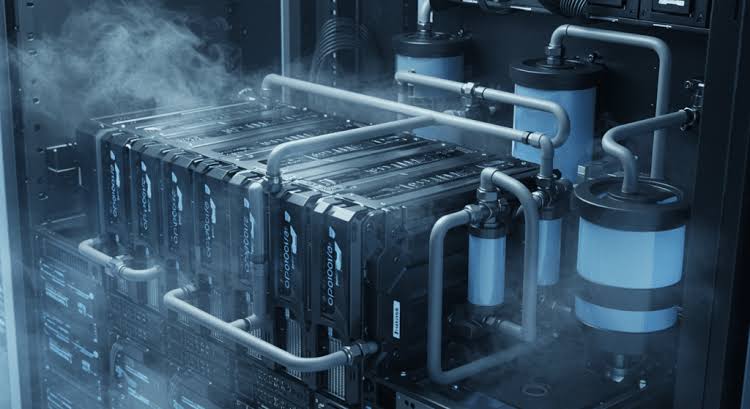
While the energy demands of artificial intelligence workloads—particularly large language model (LLM) training and high-density inference—frequently make headlines, the associated water footprint is an equally pressing environmental challenge. Thousands of high-TDP GPUs running simultaneously generate massive thermal loads that must be dissipated continuously.
Historically, hyperscale data centers relied heavily on evaporative cooling towers due to their cost efficiency and thermodynamic effectiveness. However, evaporating millions of gallons of potable water daily places significant strain on local municipal watersheds and ecosystems. As water scarcity intensifies globally, achieving extreme water efficiency has become a foundational metric for sustainable AI deployment.
By shifting from open evaporation to closed-loop Direct-to-Chip (DLC) or rear-door heat exchangers, data centers recirculate a fixed volume of treated liquid indefinitely. Heat captured from the chips is transferred via primary and secondary Coolant Distribution Units (CDUs) to dry coolers, eliminating continuous water loss.
Modern data center infrastructure management (DCIM) tools leverage machine learning to dynamically balance the trade-off between Power Usage Effectiveness (PUE) and Water Usage Effectiveness (WUE). Depending on local weather forecasts, electricity grid carbon intensity, and water availability, AI algorithms dynamically adjust fan speeds versus adiabatic water spray in real time.
Sustaining the growth of artificial intelligence requires balancing energy efficiency with water conservation. Transitioning to closed-loop liquid architectures, hybrid adiabatic systems, and intelligent multi-objective control algorithms ensures data centers can cool next-generation GPU hardware without exhausting vital local water resources.