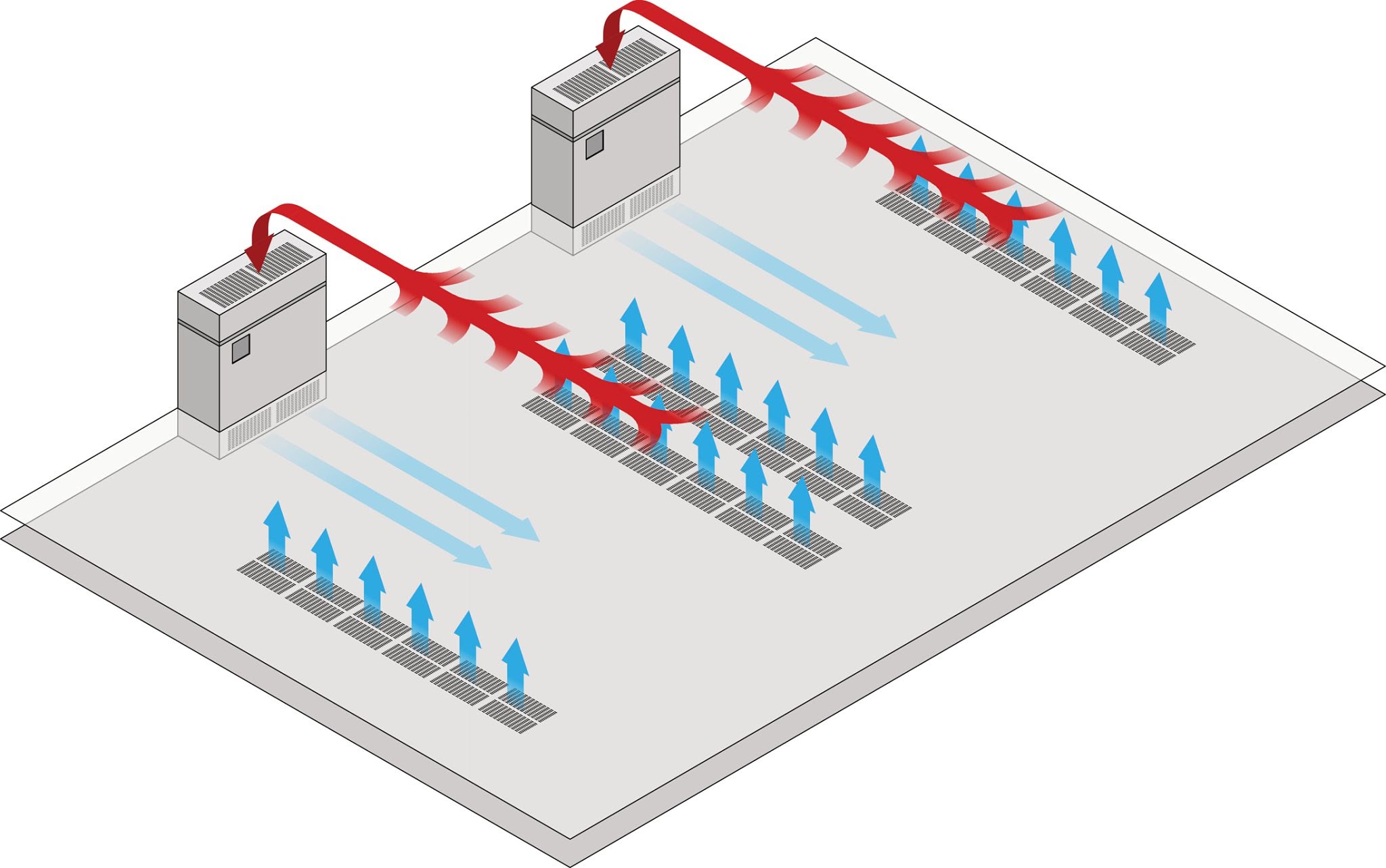
The rapid rise of large language models (LLMs) and deep learning accelerators has fundamentally altered the physical architecture of modern data centers. While traditional enterprise workloads require 5 to 10 kW per rack, high-performance AI clusters equipped with dense GPU nodes routinely demand 30 kW to over 100 kW per rack enclosure.
Air-based cooling systems—long the standard in legacy facilities—are hitting absolute physical limits. Forced air simply cannot absorb or transport thermal energy quickly enough from modern microprocessors without consuming excessive amounts of electricity. As a result, thermal management has transitioned from a supporting utility into a critical strategic priority for modern data center operators.
DLC places closed-loop liquid cold plates directly atop high-heat components (GPUs and CPUs). Coolant fluid circulates through delicate micro-channels, absorbing up to 80% of generated heat at the source before transporting it outside via secondary loop heat exchangers. Because liquid conducts thermal energy far more effectively than air, fan reliance drops significantly.
As AI compute workloads continue their exponential growth, energy efficiency in cooling infrastructure is no longer just an environmental metric—it is an operational prerequisite. Embracing hybrid liquid-air architectures, warm-water cooling, and ML-driven thermal regulation enables data centers to scale performance reliably while maintaining cost-effective, sustainable energy targets.